


xenon lights


Contributors
Joined: Mar 2008
Posts: 1,290
Likes: 0
From: Montana, USA

100% you don't want 55W on HID's it'll kill anyone in oncoming traffic! you guys doubt me? how dare you lol but seriously.. i've dealt with this stuff long enough to know what works.. OEM 35W should be more than sufficient for lighting.
in my experience 4500K makes objects less visible and over 8000K makes things less visible. inbetween you're good to go.
in my experience 4500K makes objects less visible and over 8000K makes things less visible. inbetween you're good to go.

Senior Members
Joined: Feb 2007
Posts: 461
Likes: 0
Originally Posted by schulrog' post='764141' date='Jan 9 2009, 07:13 PM
That part I don't get myself but manufacturers like to use the same scales in a different context. for example the MTEC lists their cosmos blue lights @ 4750K but they have a blueish-white light to them.
the scale i posted shows 6000K as pure white. Or just look at your OEM 4500K HID's. They're not white, they are yellowish.
the scale i posted shows 6000K as pure white. Or just look at your OEM 4500K HID's. They're not white, they are yellowish.
The fact is.... you're BOTH right.

The best way to look at it is on a CIE diagram. You can reference pure, "noonday sunlight" white at what's called "D65". This is 6500k with very specific red, green, and blue points.
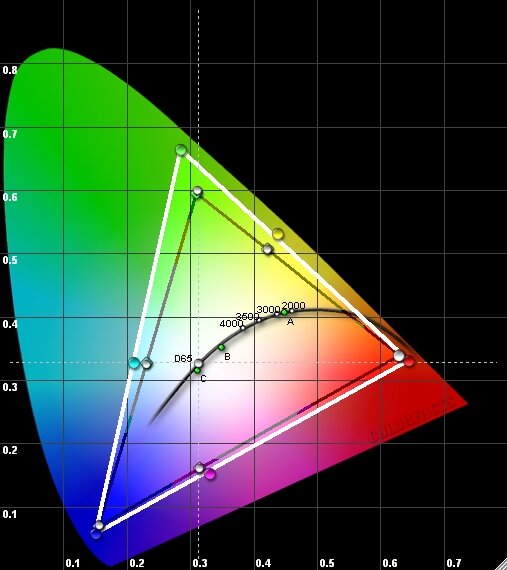
In automotive applications, the lighting used has very different natural red, green, and blue coordinates. Because of that, the point where human eyes perceive "white" is shifted from ideal, down the color temperature spectrum to roughly 4300k with Xenon lighting. With LED, which comes closer to the HT ideal coordinates, it'll go back up the scale a bit.
For xenon light in automotive applications, you get the most light at 4300k, roughly 3200 lumens at 35w, given proper design. There's an efficiency dropoff as you deviate from this point, however, the dropoff is shallow in the nearscale. Going to 5000k will only tend to drop the output by 100 lumens or so. Going to 6000k will drop the output by another couple hundred lumens. Beyond that, the output dropoff becomes more and more steep.
It's important to remember that human eyes view brightness on a sort of logarithmic scale. In other words, when the amount of light output is doubled, we only perceive a small bump in brightness. Because of this, our eyes cannot readily perceive a 10% change in brightness, so the loss in brightness associated with going to 6000k from 4300k is imperceptible. What we do see is merely the color difference.
Contributors
Joined: Dec 2007
Posts: 4,508
Likes: 0
From: Vancouver, BC
My Ride: See sig :)
What are the results of using 6000K, 7000K, 15000K HID bulbs?
Stage 1 refers to 4100K and stage 2 normally refers to something higher value K.
As an example, a 6000K bulb in some headlamps might not show much difference at all, others will look bluer. These are observations when standing in front of the car looking into the headlights from above. After getting over the initial thrill of cooler light, many drivers have noticed that important traffic information are not as apparent as with OEM standard bulb. White traffic signs are being lit too much and can feel glaring.
During winter 2002, exponential use of Kelvin (K) rating is used as brightness improving advertisement. Its all just big empty words, do a search for "Kelvin color temperature" on a search engine (i.e.: yahoo.com) and you will see that it has nothing to do with brightness and all to do with color. Going upwards from 4300K means that your light turns blue at the expense of total brightness and yellow color. Theoretically, if the same brightness were to be kept, you would have to increase the wattage of the bulb from 35 to maybe 40W, and redesign the ballast. This would be a very costly solution, so that?s pretty much why all automotive HID bulbs are 35W.
All depends on where you get the info.
Stage 1 refers to 4100K and stage 2 normally refers to something higher value K.
As an example, a 6000K bulb in some headlamps might not show much difference at all, others will look bluer. These are observations when standing in front of the car looking into the headlights from above. After getting over the initial thrill of cooler light, many drivers have noticed that important traffic information are not as apparent as with OEM standard bulb. White traffic signs are being lit too much and can feel glaring.
During winter 2002, exponential use of Kelvin (K) rating is used as brightness improving advertisement. Its all just big empty words, do a search for "Kelvin color temperature" on a search engine (i.e.: yahoo.com) and you will see that it has nothing to do with brightness and all to do with color. Going upwards from 4300K means that your light turns blue at the expense of total brightness and yellow color. Theoretically, if the same brightness were to be kept, you would have to increase the wattage of the bulb from 35 to maybe 40W, and redesign the ballast. This would be a very costly solution, so that?s pretty much why all automotive HID bulbs are 35W.
All depends on where you get the info.
Contributors
Joined: Mar 2008
Posts: 1,290
Likes: 0
From: Montana, USA
Originally Posted by NobleForums' post='765149' date='Jan 11 2009, 01:52 PM
The fact is.... you're BOTH right.
The best way to look at it is on a CIE diagram. You can reference pure, "noonday sunlight" white at what's called "D65". This is 6500k with very specific red, green, and blue points.
In automotive applications, the lighting used has very different natural red, green, and blue coordinates. Because of that, the point where human eyes perceive "white" is shifted from ideal, down the color temperature spectrum to roughly 4300k with Xenon lighting. With LED, which comes closer to the HT ideal coordinates, it'll go back up the scale a bit.
For xenon light in automotive applications, you get the most light at 4300k, roughly 3200 lumens at 35w, given proper design. There's an efficiency dropoff as you deviate from this point, however, the dropoff is shallow in the nearscale. Going to 5000k will only tend to drop the output by 100 lumens or so. Going to 6000k will drop the output by another couple hundred lumens. Beyond that, the output dropoff becomes more and more steep.
It's important to remember that human eyes view brightness on a sort of logarithmic scale. In other words, when the amount of light output is doubled, we only perceive a small bump in brightness. Because of this, our eyes cannot readily perceive a 10% change in brightness, so the loss in brightness associated with going to 6000k from 4300k is imperceptible. What we do see is merely the color difference.
The best way to look at it is on a CIE diagram. You can reference pure, "noonday sunlight" white at what's called "D65". This is 6500k with very specific red, green, and blue points.
In automotive applications, the lighting used has very different natural red, green, and blue coordinates. Because of that, the point where human eyes perceive "white" is shifted from ideal, down the color temperature spectrum to roughly 4300k with Xenon lighting. With LED, which comes closer to the HT ideal coordinates, it'll go back up the scale a bit.
For xenon light in automotive applications, you get the most light at 4300k, roughly 3200 lumens at 35w, given proper design. There's an efficiency dropoff as you deviate from this point, however, the dropoff is shallow in the nearscale. Going to 5000k will only tend to drop the output by 100 lumens or so. Going to 6000k will drop the output by another couple hundred lumens. Beyond that, the output dropoff becomes more and more steep.
It's important to remember that human eyes view brightness on a sort of logarithmic scale. In other words, when the amount of light output is doubled, we only perceive a small bump in brightness. Because of this, our eyes cannot readily perceive a 10% change in brightness, so the loss in brightness associated with going to 6000k from 4300k is imperceptible. What we do see is merely the color difference.
that's the info I always go by. NICE chart man!

Thread
Thread Starter
Forum
Replies
Last Post
Beemer
E60, E61 Parts, Accessories and Mods
33
Jan 14, 2019 05:13 AM
Doctor Diesel
Dealer Purchasing & Service Forum
11
Apr 26, 2004 07:18 AM
dv8ed
Dealer Purchasing & Service Forum
4
Dec 24, 2003 07:41 PM